
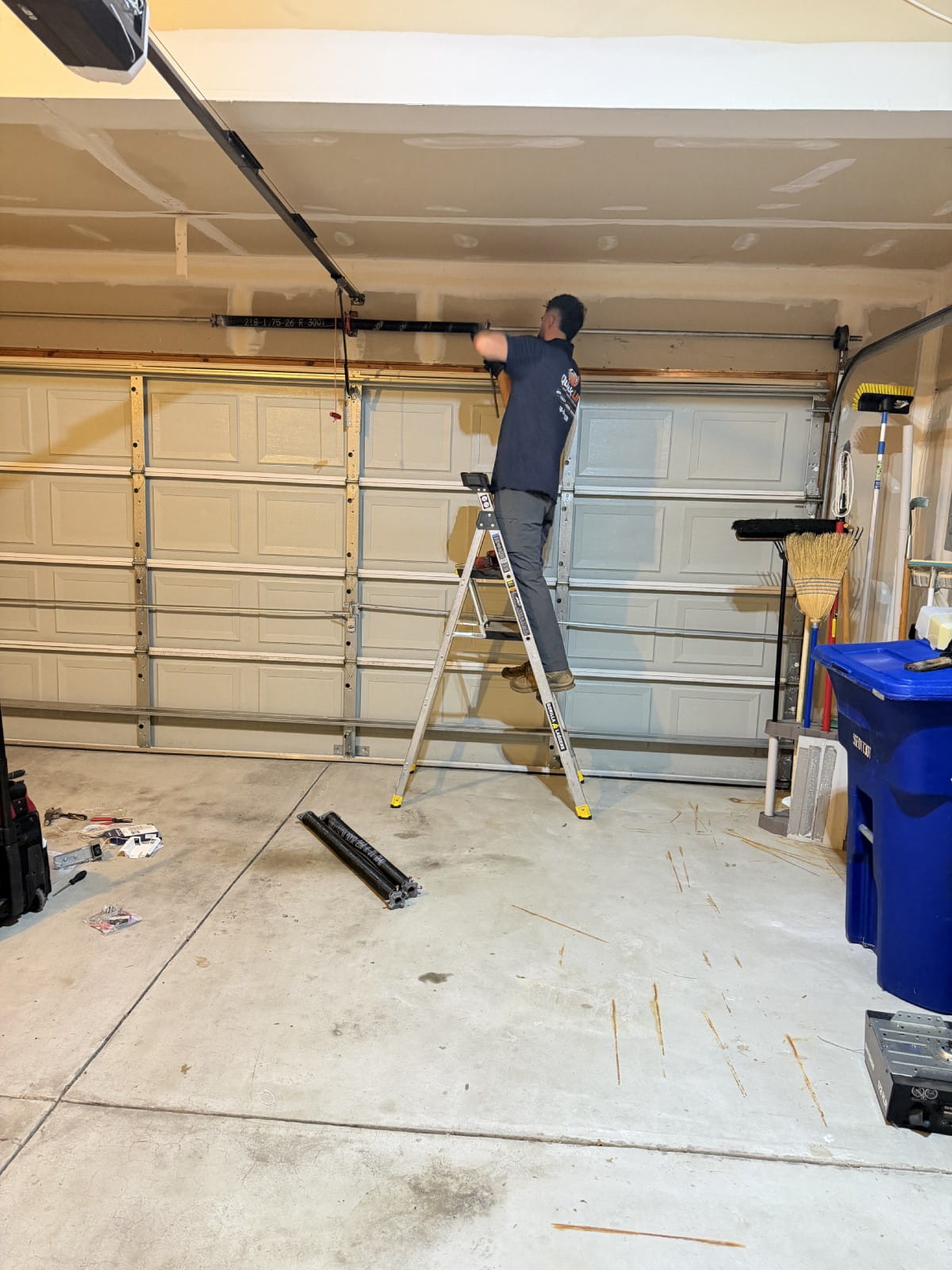
Overview of Garage Door Extension Spring Repair in Marlton
Garage door extension spring repair in Marlton involves replacing or balancing high-tension steel coils mounted parallel to upper horizontal tracks. We ensure safe, balanced door operation by removing compromised springs, selecting precisely calibrated wire gauges, installing safety containment cables, and aligning counterweights to prevent premature opener fatigue.
In Marlton and neighboring Voorhees, Southern New Jersey climate fluctuations expose garage door hardware to thermal expansion, high summer humidity, and freezing winter temperatures. Over time, these conditions accelerate metal fatigue in extension springs, which expand and contract every time your door operates. Extension spring systems stretch along horizontal tracks to counterbalance door weight, making proper sizing and tension alignment critical for smooth lifting. When an extension spring loses temper or snaps, the resulting load imbalance places immediate stress on cables, pulleys, and the overhead operator.
Diagnostic Identifiers and Failure Modes of Extension Springs
Diagnosing extension spring failure requires identifying physical spring elongation, uneven door alignment, binding tracks, or visible coil separation. We systematically measure door balance, inspect pulley wear, and evaluate stretch tension to determine whether spring fatigue, rust friction, or incorrect weight matching caused the mechanical failure.
Over years of field service across Marlton and Voorhees, we frequently encounter severe door misalignment caused by asymmetric spring stretch. In a recent complex service call off Route 73 in Marlton, a homeowner reported that their double-car garage door was jamming halfway up and making severe grinding noises. Upon inspection, we discovered that a previous quick-fix had paired a 110-pound capacity spring on the left side with a 130-pound spring on the right. This mismatched tension caused the door to tilt five degrees out of plumb, binding the roller stem inside the track and burning out the opener gear kit.
To resolve this issue, we calculated the total door weight using a mechanical analog scale and replaced both extension springs with a calibrated pair rated for 120 pounds each. We replaced the worn pulley sheaves, re-strung high-tensile aircraft cables, and installed stainless steel safety containment cables through both spring cores. Once tension was balanced and track tolerances were reset, the door operated manually with under five pounds of hand effort, restoring smooth automated travel. Below is a technical comparison between traditional extension springs and overhead torsion spring counterbalance systems.
| Feature / Metric | Extension Spring System | Torsion Spring System |
|---|---|---|
| Mounting Location | Parallel to upper horizontal tracks | Centered above the door opening |
| Primary Force Vector | Horizontal pulling / linear stretch | Rotational torque across solid shaft |
| Estimated Life Expectancy | 7,000 to 10,000 cycles | 10,000 to 20,000 cycles |
| Safety Containment Requirement | Mandated internal safety cable | Enclosed central shaft contains broken coils |
| Maintenance Complexity | High (dual pulley and cable adjustment) | Moderate (stationery anchor calibration) |
| System Cost | Lower initial component cost | Higher initial hardware investment |
Technical Repair Framework and Safety Protocols
Our technical repair process prioritizes mechanical safety, precise weight matching, and strict containment standards. We isolate spring tension, match spring specifications according to standardized color codes, install containment cables, and adjust pulley cable lengths to guarantee symmetrical lift performance across all horizontal track pathways.
Spring replacement demands absolute compliance with engineering standards set by the Door & Access Systems Manufacturers Association (DASMA). DASMA color-coding standards assign specific color bands to extension springs based on door weight capacities in ten-pound increments. Installing improper springs creates severe mechanical instability, overloading automatic openers or causing doors to slam shut unexpectedly.
According to trauma statistics compiled by the U.S. Consumer Product Safety Commission (CPSC), thousands of emergency room visits occur annually due to DIY garage door repairs involving high-tension spring release. Extension springs under load contain immense kinetic potential, which can fling heavy metal coils across a garage if an end loop breaks.
Our technicians complete extension spring repairs following five strict sequential steps:
- Disconnect opener motor power and lock garage door panels securely in the closed position with track locking pliers.
- Relieve residual spring tension using safety clamping equipment before detaching lift cables from bottom corner brackets.
- Calculate door weight and select replacement springs matching standardized DASMA color codes and wire dimensions.
- Thread heavy-duty steel safety containment cables through the center of each spring and anchor them to rigid track supports.
- Re-engage lift cables onto pulley sheaves, set equal initial stretch, and run full balance and auto-reverse safety tests.
Spring Selection and Trade-Off Analysis
Selecting garage door springs requires balancing long-term durability, initial cost, and structural safety requirements. We help Marlton homeowners evaluate standard oil-tempered extension springs, galvanized high-cycle extension options, or full conversion to overhead torsion spring assemblies depending on usage volume and garage layout.
If your garage door experiences light daily usage of two cycles or fewer, standard oil-tempered extension springs provide a cost-effective solution with a typical 7,000 to 10,000 cycle lifespan. However, if your household opens the garage door four or more times daily, high-cycle extension springs or a complete torsion spring conversion yields lower long-term cost per cycle. Torsion conversions replace exposed stretching springs with a centralized shaft system, offering smoother operation and eliminating side-wall clearance restrictions.
Failure to install safety cables inside extension springs represents one of the most dangerous common failure modes we observe in older Marlton homes. Without a safety cable, a breaking extension spring snaps wild, damaging vehicles, drywall, or causing severe personal injury. We recommend immediate conversion to torsion springs if your ceiling geometry permits, or mandating safety cable installation on all existing extension setups.
Frequently Asked Questions
How do I know if my garage door extension spring is broken or failing?
You can spot a failing extension spring by looking for visible gaps in the coils, stretched non-rebounding springs, or an uneven door that hangs crooked in the track. You may also notice your automatic opener struggling or stopping midway during operation due to excessive uncounterbalanced door weight.
Is it safe to replace a garage door extension spring myself?
No, replacing extension springs yourself is extremely hazardous due to high kinetic tension stored within the spring system. Attempting DIY repairs without specialized containment tools can result in sudden spring snapping, severe impact injuries, or structural damage.
Why must both extension springs be replaced at the same time?
Both extension springs must be replaced together because garage door springs experience identical cycle wear and metal fatigue over time. Replacing only one spring creates uneven lift tension across the door, leading to off-track binding, rapid roller wear, and early failure of the new spring.
What is the purpose of a garage door safety cable on extension springs?
A safety cable runs through the center of an extension spring and anchors to the wall or horizontal track to contain the spring if it breaks. Without this cable, a snapped spring becomes a dangerous projectile that can strike vehicles or people nearby.
How long do garage door extension springs typically last in Marlton homes?
Garage door extension springs typically last between five and seven years in Southern New Jersey, which translates to roughly 7,000 to 10,000 open-and-close cycles. Factors such as winter freeze cycles, ambient humidity, door weight, and daily operational frequency directly impact overall lifespan.
Sources
- Door & Access Systems Manufacturers Association (DASMA): https://www.dasma.com
- U.S. Consumer Product Safety Commission (CPSC): https://www.cpsc.gov